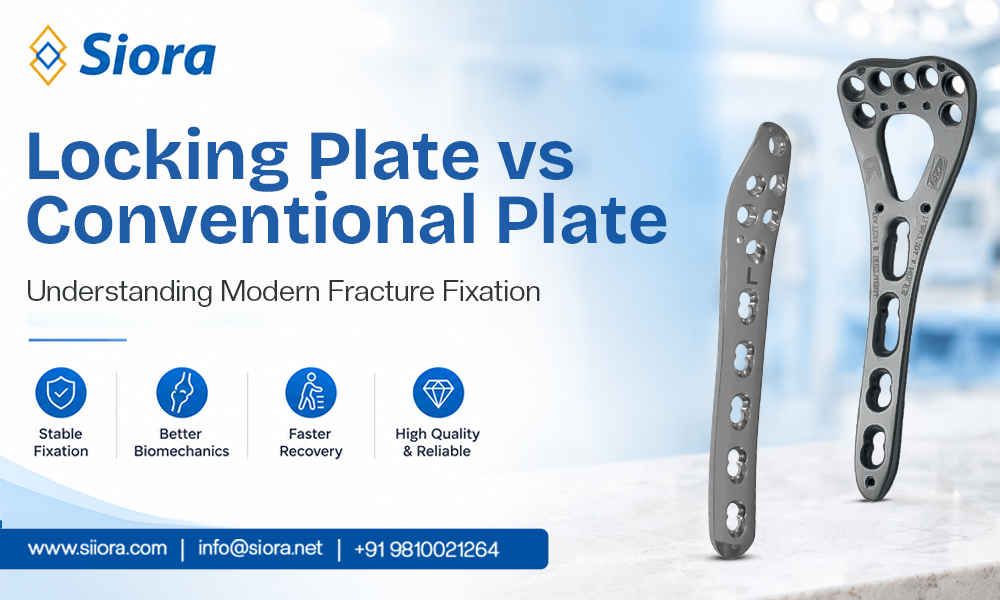
Fractures can vary considerably in their location, severity, and complexity. Choosing the right fixation method is therefore an important part of fracture management. Among the commonly used options, locking plates and conventional plates serve different purposes in stabilizing broken bones and supporting the healing process. Although both systems help maintain fracture alignment, they differ in how screws interact with the plate and how stability is achieved.
Understanding these differences helps explain why orthopaedic surgeons may prefer one fixation method over another, depending on the patient’s condition, bone quality, and fracture pattern.
What Is a Locking Plate?
A locking plate is an orthopaedic implant designed with threaded holes that allow compatible locking screws to connect securely with the plate. Once tightened, the screw head locks into the plate, creating a fixed-angle construct.
Unlike traditional fixation methods, this design does not rely entirely on friction between the plate and the surface of the bone. Instead, the plate and screws work together as a stable structure.
What Are the Key Features of Locking Plates?
- Fixed-angle stability: The locking mechanism helps maintain the angle between the plate and screws.
- Reduced dependence on bone quality: The construct can be particularly useful in osteoporotic bone, although clinical suitability depends on the fracture and fixation technique.
- Support for complex fractures: Locking plates are frequently used for comminuted fractures, periarticular fractures, and situations where maintaining alignment is challenging.
- Versatile fixation options: Certain systems allow surgeons to combine locking and conventional screws when appropriate.
These characteristics make locking plates an important option in modern fracture fixation, particularly when conventional screw purchase may be less reliable.
What Is a Conventional Plate?
A conventional plate, often called a non-locking plate, generally uses screws that compress the plate against the bone. When the screws are tightened, the resulting friction between the plate and bone helps stabilize the fracture.
This method has a long history in orthopaedic surgery and remains valuable for suitable fracture patterns.
What Are the Key Features of Conventional Plates?
- Bone-to-plate compression: Screws draw the plate toward the bone, helping create stability through friction.
- Established fixation technique: Conventional plating is widely used for fractures where adequate bone purchase and suitable anatomical conditions are present.
- Flexibility in screw placement: Depending on the plate design, screw positioning can help achieve compression across selected fracture sites.
- Cost considerations: Conventional systems may be a practical option in cases where locking technology offers no clear clinical advantage.
However, conventional plates may be less suitable when bone quality is poor or when achieving reliable screw purchase is difficult.
How Do Surgeons Choose Between the Two?
The decision involves more than selecting an implant based on its design. Surgeons assess fracture location, displacement, bone quality, soft-tissue condition, and the stability required for healing.
Locking plates may be advantageous in fractures near joints, multifragmentary injuries, or cases involving compromised bone quality. Conventional plates may be appropriate when fracture compression is desirable, and sufficient bone quality allows dependable screw fixation.
In some situations, hybrid fixation using both locking and conventional screws can provide useful mechanical advantages. Correct implant positioning, surgical technique, and postoperative rehabilitation also influence outcomes.
Conclusion
Locking and conventional plates remain important tools in fracture management, each offering distinct mechanical benefits. Locking plates provide fixed-angle stability, while conventional plates rely primarily on compression and friction between the plate and bone. Understanding these differences supports informed implant selection and effective surgical planning.
Ultimately, successful fracture fixation depends on matching the trauma implant system to the individual clinical situation rather than assuming that one technology is always the better choice.

